The Hidden Danger of Leverage: How a Winning Strategy Goes to Zero
A strategy that turns $10,000 into $82,000 at 1x leverage can go completely bankrupt at 10x. The difference? Max drawdown. Here's why most traders get this wrong.
Leverage is the most misunderstood tool in trading. Every beginner thinks it's a multiplier for profits. In reality, it's a multiplier for everything — including the drawdowns that wipe you out.
We ran the same strategy on the same asset over the same time period, changing only the leverage. The results speak for themselves.
The Experiment
We took a trend-following strategy on BTC/USDT, backtested over 5 years (2020–2025). Starting capital: $10,000. The rules are straightforward:
Buy when Close > SMA(50) and Close > EMA(7) and RSI(2) > ADX(2)
Exit when RSI(2) < ADX(2)
A classic trend-following setup: the SMA(50) confirms the long-term trend, the EMA(7) confirms short-term momentum, and the RSI/ADX crossover times the entries and exits. Nothing exotic — a clean, rule-based strategy that many traders use as a starting point.
At 1x Leverage: A Solid Winner
With no leverage, the strategy grew the initial $10,000 to over $82,000 — an 8x return over 5 years. It outperformed buy & hold for most of the period, with controlled drawdowns that never exceeded 30%.
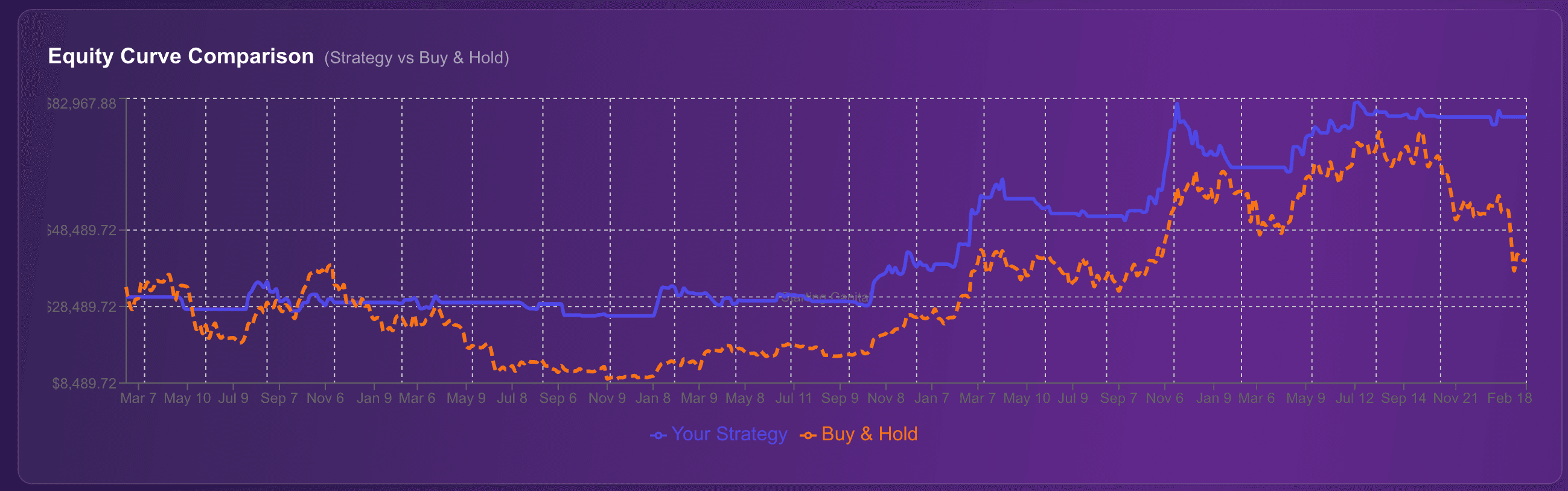
This looks great. Consistent growth, manageable risk, and a clear edge over the market. Most traders would look at this chart and think: “Imagine this at 10x.”
At 3x Leverage: The Sweet Spot
Here's the thing — leverage isn't inherently bad. When controlled, it's one of the most powerful tools in trading.
For this trend-following strategy, 3x leverage is the optimal level. The account grows from $10,000 to over $158,000 — nearly double the 1x result — while the drawdowns remain survivable. The equity curve has more volatility than 1x, but the strategy never comes close to blowing up.
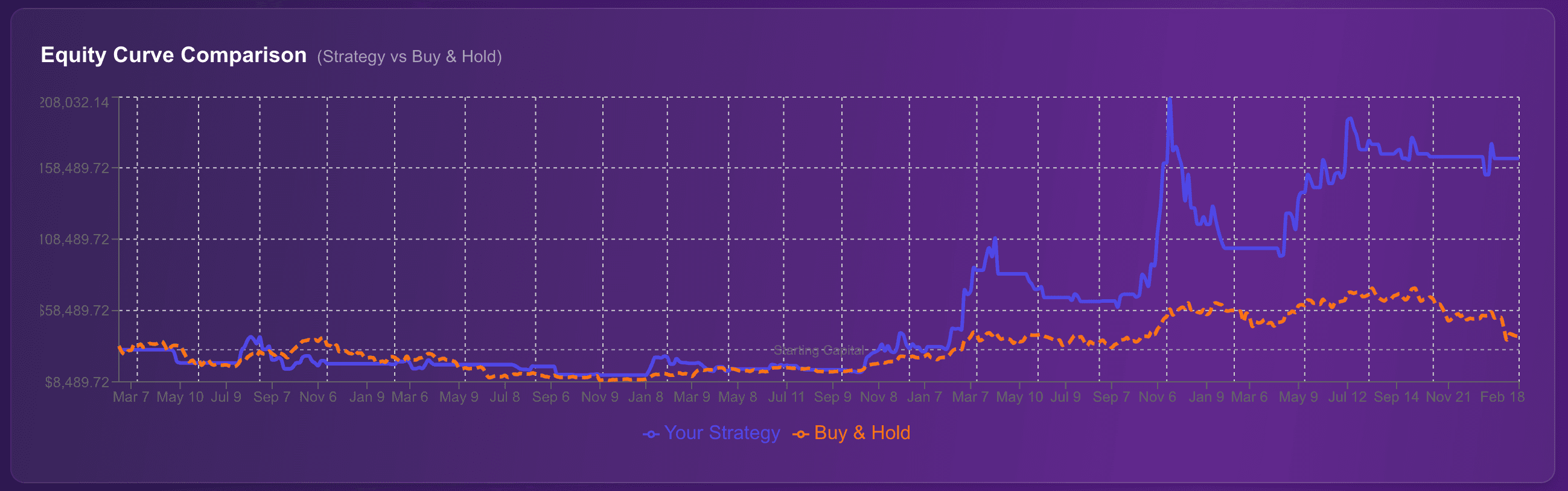
Why does 3x work here? Because this strategy's max drawdown at 1x is 26.72%. At 3x, that scales to 68.58% — painful, but recoverable. The strategy has enough edge to climb back from those drawdowns and continue compounding.
Leverage Is a Tool, Not a Villain
The key is finding the right amount for your specific strategy. A strategy with a 15% max drawdown can safely handle 3x. A strategy with a 5% max drawdown might handle 10x. It all depends on the numbers — not on gut feeling.
But what happens when traders get greedy and push past the safe zone?
The Temptation
“3x turns $10k into $158k. Imagine what 10x could do!”
This is the single most dangerous assumption in trading. Here's what actually happens.
At 10x Leverage: Complete Bankruptcy
Same strategy. Same asset. Same time period. The only change: 10x leverage.
The account was wiped out within the first few months. A single drawdown that was perfectly survivable at 1x became a death sentence at 10x. The equity curve flatlined near $0 and never recovered.
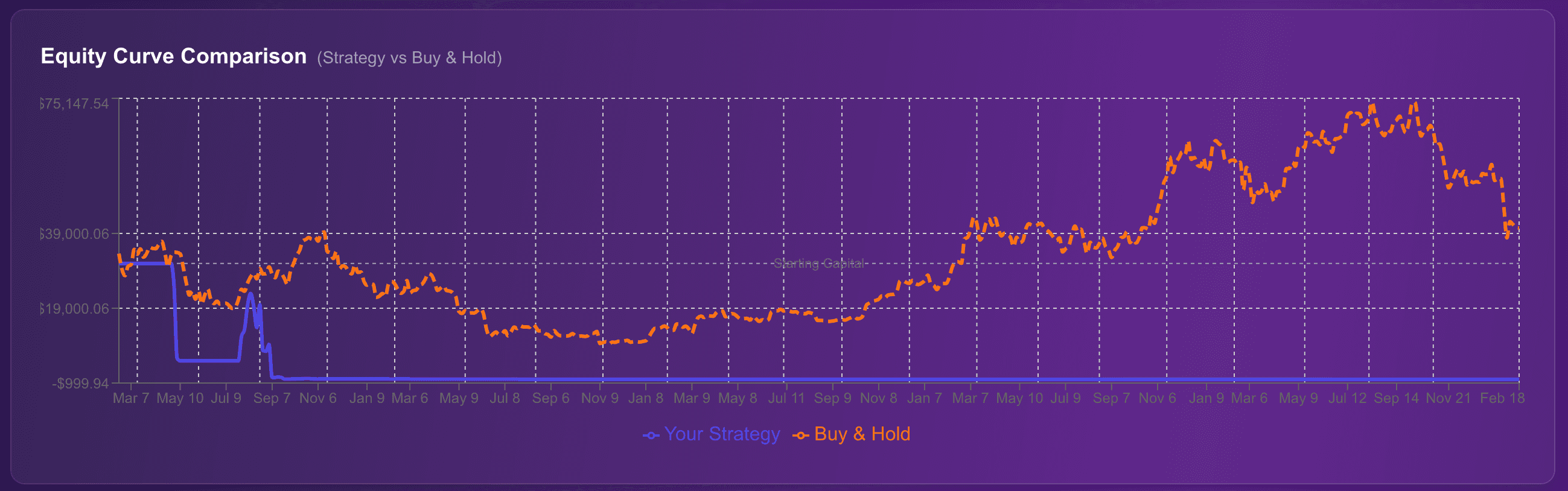
And if you're thinking about going even higher — don't. If a strategy can't survive at 10x, it won't survive at 20x, 50x, or 100x either. Higher leverage doesn't magically fix the problem — it makes the liquidation happen faster. At 20x, this strategy would have been wiped out in days, not months. At 50x or 100x, a single bad candle is enough.
Why This Happens: The Math of Drawdowns
The key metric is max drawdown. Our strategy has a max drawdown of 26.72% at 1x leverage. At 3x, that scales to 68.58% — painful but survivable. At 5x, it hits 90.74% — one bad day away from liquidation. At 10x, it reaches 100% — total wipeout.
| Leverage | Max Drawdown | Outcome |
|---|---|---|
| 1x | 26.72% | Profitable — $82k |
| 3x | 68.58% | Best risk/reward — $158k |
| 5x | 90.74% | Near-death — barely survives |
| 10x | 100% | Bankrupt — $0 |
The formula is simple: effective_drawdown = max_drawdown × leverage. If the effective drawdown exceeds 100%, your account is gone.
The Rule: Max Safe Leverage
Before applying any leverage, you need to know your strategy's max drawdown. Then apply this rule:
max_leverage = 1 / max_drawdown
Our strategy has a 26.72% max drawdown: 1 / 0.2672 = ~3.7x max safe leverage.
That's why 3x works and 5x is already on the edge (90.74% drawdown).
And even this is the theoretical maximum. In practice, you should use half of this value because future drawdowns will almost certainly be larger than historical ones. Markets evolve, black swans happen, and past performance is never a guarantee.
Key Insight
Very few strategies can sustain leverage above 5x over the long term. The ones that can typically have max drawdowns under 10% — which usually means they trade very infrequently or use extremely tight risk management. For most strategies, 2x–3x is the practical ceiling.
What You Should Do Instead
- 1Backtest at 1x first. Make sure the strategy is profitable without leverage. If it's not profitable at 1x, leverage will only make it lose money faster.
- 2Check your max drawdown. This is the single most important metric for leverage decisions. Not win rate, not total return — max drawdown.
- 3Apply the formula conservatively. Calculate
1 / (2 × max_drawdown)and use that as your ceiling. - 4Re-backtest with leverage. Use Backtestor's leverage slider to see the actual equity curve at your target leverage. If the curve goes to zero in the backtest, it will go to zero in real life.
Test Your Strategy Before You Risk Real Money
Use Backtestor to simulate any leverage level on your strategy. See the equity curve, max drawdown, and risk metrics before going live.
Try Backtestor FreeLeverage doesn't create edge. It amplifies whatever edge — or lack of edge — you already have. The traders who survive long-term are the ones who respect drawdowns and size their leverage accordingly. Don't let a winning strategy become a losing one just because you wanted faster returns.